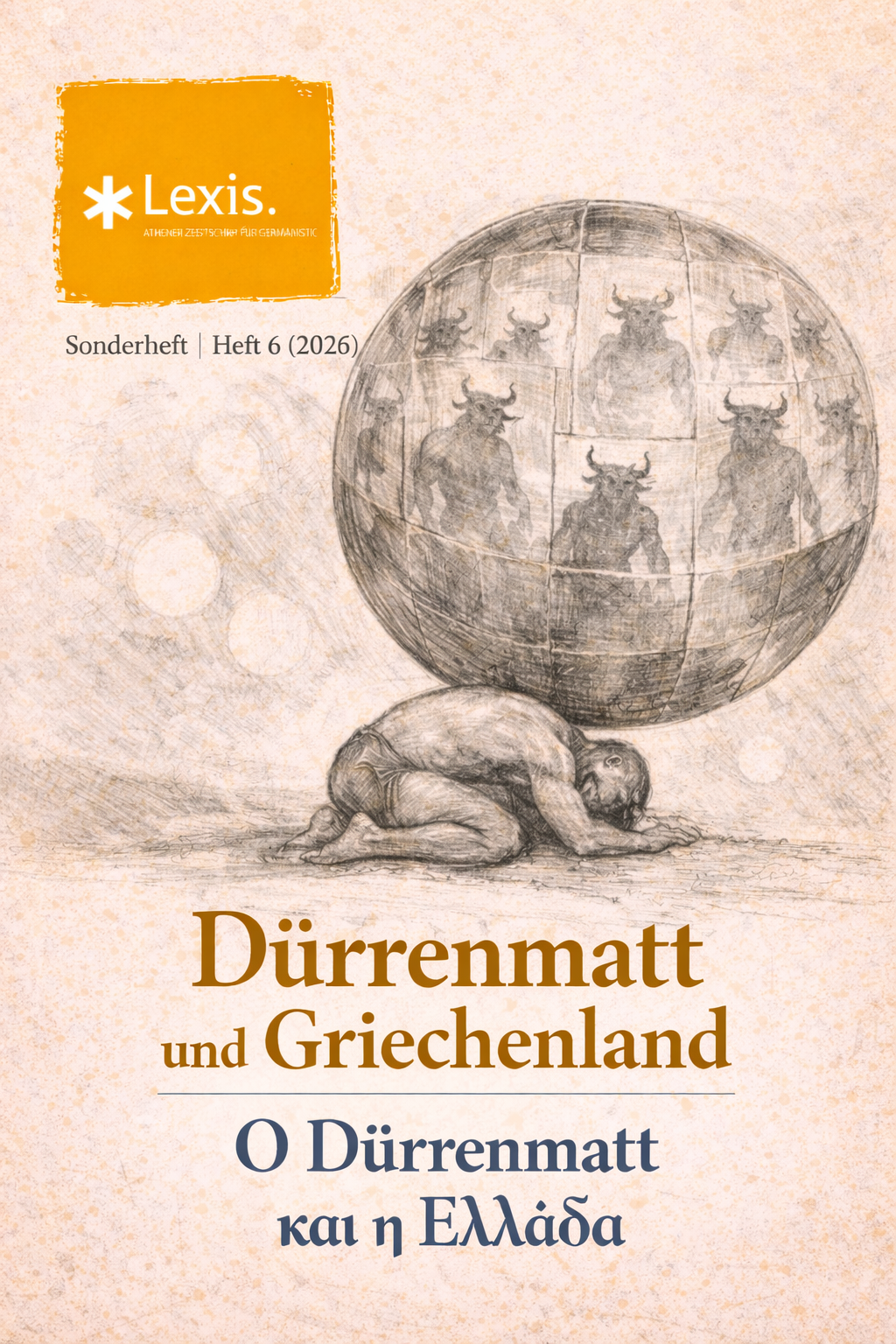
Ο Friedrich Dürrenmatt ως θεατρικός συγγραφέας. Η επίσκεψη μιας γηραιάς κυρίας τόσο Ευρωπαίας όσο και Ελληνίδας
DOI:
https://doi.org/10.26247/lexis.2919Abstract
The article examines Friedrich Dürrenmatt’s play The Visit (1956) as a crucial allegory of modern European society and of the moral disintegration brought about by the omnipotence of money. Through its tragicomic structure, it highlights the gradual shift of an economically impoverished community from moral refusal to collective guilt, insofar as economic salvation becomes inextricably linked to the murder of an individual. Particular emphasis is placed on the figure of Claire Zachanassian, who is traced as a modern tragic heroine with explicit references to ancient Greek tragedy (Clotho, Lais, Medea), and as an embodiment of absolute and relentless power.
The article further underscores the instrumentalization of excess, absurdity, and alienation, the systematic dismantling of democratic procedures, and the concept of Necessity as a determining force that neutralizes individual responsibility. Finally, it brings to light the enduring relevance of the play and its potential to be read both as a European and as a specifically Greek experience of crisis and collective guilt.