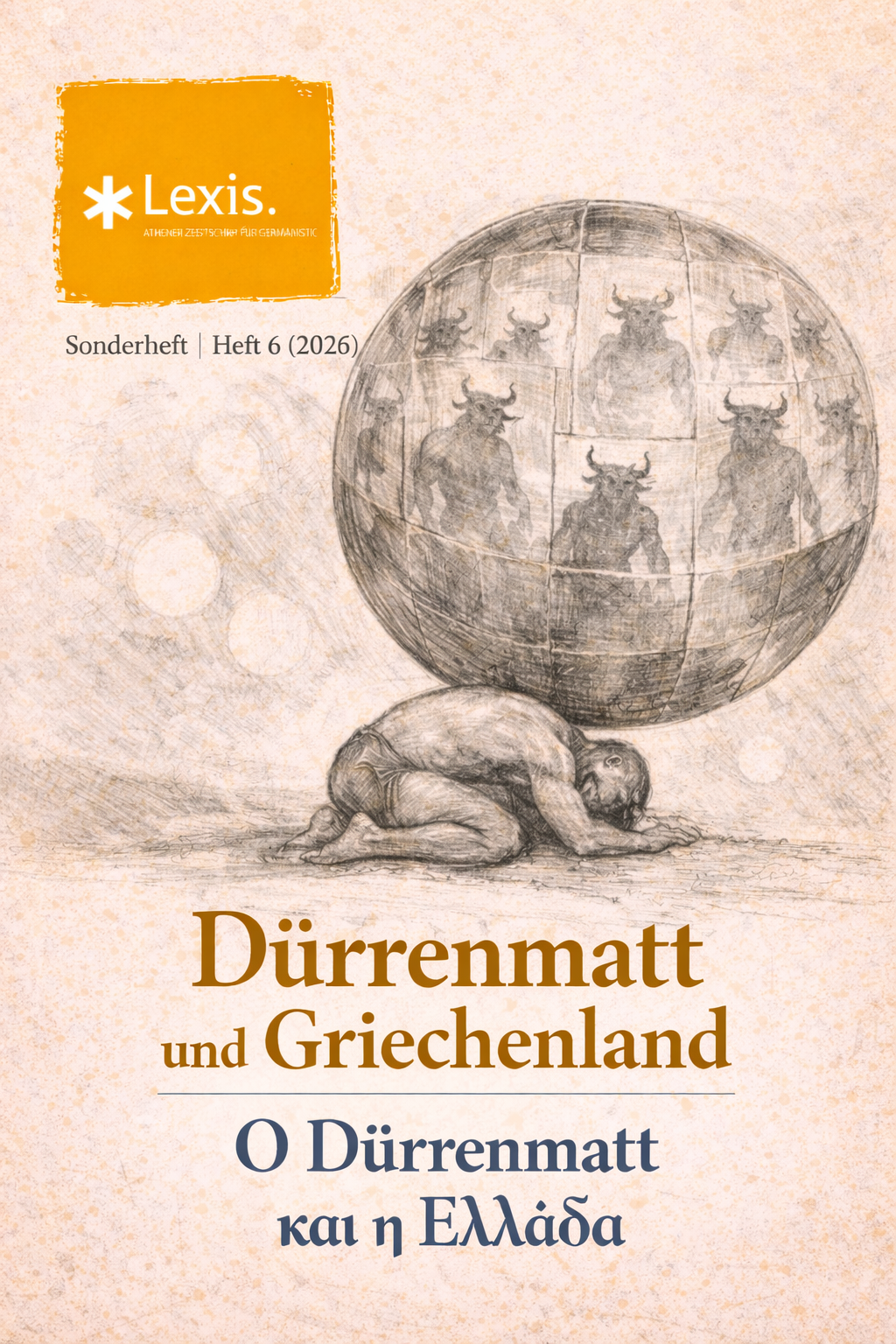
Ο Friedrich Dürrenmatt, η Ελλάδα και η ατέρμονη κωμωδία του κόσμου
DOI:
https://doi.org/10.26247/lexis.2925Abstract
This article approaches the work of Friedrich Dürrenmatt as a coherent aesthetic and philosophical whole, while shedding light on a less explored yet crucial dimension: his ongoing dialogue with the Greek intellectual tradition. Through a comprehensive perspective encompassing his theatre, prose, and theoretical writings, it is argued that “Greekness” in his work does not function as an exotic ornament or merely an intertextual element, but rather as an interpretive and conceptual framework. Particular emphasis is placed on the shift from tragedy to tragicomedy and on the deconstruction of logic and order through hybrid narrative forms, such as the pseudo-detective novel. At the same time, attention is drawn to the creative appropriation of Greek mythology as a means of revealing the asymmetry of contemporary reality. In both his dramatic and narrative texts, Dürrenmatt does not resolve conflicts but rather exposes them, highlighting the gap between human intention and impersonal reality. His writing thus constitutes a contemporary “poetics of the labyrinth,” in which art does not offer solutions, but rather exposes the fractures inherent in modernity. The study concludes that Dürrenmatt’s connection with Greece embodies a deeper cosmological affinity, characterized by a shared sensitivity to the tension between order and chaos, and a view of art as an act of knowledge and confrontation with truth.